A privacy fence is the obvious answer, and for a flat suburban boundary it is usually the right one. This page gives you real fence costs first, because you deserve the actual number before anyone sells you an alternative.
Then it covers the situations where a fence cannot do the job at any price. Not “costs more” — cannot. That distinction is the whole reason this company exists, and we will come back to our own hillside at the end.
How much does a privacy fence cost?
Across published 2026 national cost guides, a six-foot privacy fence installed by a contractor runs roughly $18 to $85 per linear foot depending on material. Labour alone is $10 to $20 per foot and typically accounts for about half the total. A whole typical residential fence project lands between $5,000 and $12,000.
| Fence type | Installed cost per foot | 100 ft run | Typical lifespan |
|---|---|---|---|
| Pressure-treated pine | $18 – $38 | $1,800 – $3,800 | 12 – 20 years |
| Cedar | $25 – $55 (avg. $35 – $40) | $2,500 – $5,500 | 20 – 30 years |
| Western red cedar, clear grade | $45 – $90 | $4,500 – $9,000 | 25 – 35 years |
| Vinyl / PVC | $28 – $85 | $2,800 – $8,500 | 25 – 30 years |
| Composite | $35 – $95 | $3,500 – $9,500 | 25 – 30 years |
| Chain link plus privacy slats | $32 – $71 (slats add $3 – $10) | $3,200 – $7,100 | 15 – 25 years |
Those are installed figures for a straightforward job. Costs climb with sloped ground, rocky soil, tree roots, corner posts, gates, and permit fees. A gate alone commonly adds $300 to $800.
Where these numbers come from. The ranges above are published 2026 national averages compiled from independent cost guides including HomeGuide, Angi and Homewyse. They are not our prices and we do not sell fencing. Regional variation is wide — labour rates, permit fees, terrain and material availability all move the number, so get two or three local quotes before budgeting anything. We include these figures because you should be able to compare honestly, not because we can predict your invoice.
The number most quotes leave out: a wooden fence is not a one-time purchase. Staining or sealing every two to three years runs $2 to $5 per foot each time. Over a 20-year life that maintenance can equal a third of the original installation cost, and at the end of it you replace the fence.
How much does a bamboo privacy screen cost?
A clumping bamboo screen planted at proper spacing costs $15 to $45 per linear foot depending on the size of plant you start with. The variable that moves the price is not the species — it is how much of the growing you buy versus how much you do yourself.
| Starting size | Cost per plant | Plants per 100 ft | 100 ft run | Screen in year |
|---|---|---|---|---|
| 3-gallon | $35 – $60 | 20 – 25 | $700 – $1,500 | 3 – 4 |
| 7-gallon | $70 – $110 | 20 – 25 | $1,400 – $2,750 | 2 – 3 |
| 15-gallon | $130 – $200 | 20 – 25 | $2,600 – $5,000 | 1 – 2 |
| 25-gallon and up | $250 – $450 | 20 – 25 | $5,000 – $11,250 | Immediate |
Add roughly $2 to $6 per foot for soil amendment, mulch and dripline if you are doing it properly. Planting labour, if you hire it, is usually $30 to $60 per plant.
These bamboo figures are typical retail nursery ranges across the trade, quoted the same way as the fence numbers above — for comparison, not as a quotation. Container sizes, species availability and delivery distance all move them. For a real figure on your own run, the Bamboo Selector will give you a plant count and price band in about a minute.
So on a like-for-like 100 ft run, mid-size bamboo lands close to a cedar fence. The difference is what happens next.
Bamboo vs fence cost over twenty years
A fence is a depreciating asset. It is at its best the day it goes up and declines from there. A bamboo screen is the opposite: it costs the same to install and then gets better, taller and denser every year at no additional cost.
| Cedar fence, 100 ft | Bamboo screen, 100 ft (7-gal) | |
|---|---|---|
| Year 0 install | $2,500 – $5,500 | $1,400 – $2,750 |
| Maintenance to year 20 | $1,200 – $3,000 (staining) | $200 – $600 (feed, occasional thinning) |
| Condition at year 20 | Due for replacement | Mature, dense, full height |
| Replacement at year 20 | $2,500 – $5,500 again | $0 |
| Twenty-year total | $6,700 – $14,000 | $1,600 – $3,350 |
Over two decades bamboo comes out roughly four times cheaper, and that is before you count the fact that the fence is now a flat panel of the same six feet it always was, while the bamboo is thirty feet of moving green.
Where the fence wins, honestly. A fence gives you privacy the day it is installed. Bamboo does not. If you are selling the house in eighteen months, or you need a barrier that stops a dog or a toddler, buy the fence. We would rather tell you that than sell you plants that disappoint you.
When a privacy fence is not an option at all
Everything above is a cost comparison, which assumes both options can actually solve your problem. Often they cannot, and this is the part almost no fencing article will tell you.
Elevation: when the land next door sits above your fence line

This is our situation, and it is the reason this business exists. There is roughly a 40 foot elevation gain between our property and the development that went in next door. The houses are not beside us, they are above us, looking down.
A six-foot fence on that boundary blocks nothing. Neither does an eight-foot fence, or a twelve-foot fence, because the sightline comes from above the fence line, not through it. To block a view from 40 feet up, a fence at the property line would need to be taller than 40 feet. That is not a budget problem. It is not legal, not structurally sane, and no contractor would build it.

A screen only has to be tall enough to interrupt the line between their window and your garden — and because plants keep growing, a living screen can reach heights no fence permit will ever allow. Our bamboo passed the height a fence could legally have been in its second season, and it has not stopped since.
Height limits: when six feet of fence is not enough
Most residential zoning caps fences at six feet in rear yards and four feet in front, and HOA covenants are frequently stricter. If you need more than six feet of screening — and if anything overlooks you, you do — a fence is capped by law before it is capped by budget.
Planting is almost never regulated the same way. A hedge is landscaping, not a structure, so it typically falls outside fence height ordinances entirely. Check your own covenants, but this asymmetry is why hedges solve problems fences legally cannot.
Slopes and rock: ground that will not hold fence posts
Fence posts need footings, and footings need diggable, stable ground. On a steep slope, over ledge rock, across a drainage swale or through mature tree roots, post setting becomes the entire cost of the job. Contractors price these conditions at a heavy premium or decline them.
Bamboo needs a planting hole, not a footing. On a slope it is an advantage rather than an obstacle: the root mass binds the soil and reduces erosion, where a fence line on the same grade needs stepped panels that leave triangular gaps under every section.
Long boundaries: where fence cost scales and bamboo does not
Cost scales linearly with a fence and there is no relief. At 400 feet a cedar fence is a $12,000 to $22,000 project. Bamboo at the same length starts around $5,600 in 7-gallon stock, and the longer the run, the wider that gap becomes.
Bamboo or a fence: which should you actually choose?
A fair summary, including the cases where we lose the sale:
| Your situation | Choose |
|---|---|
| Flat boundary, need privacy now, selling soon | Fence |
| Need to contain a dog or child | Fence |
| Boundary under 30 ft | Fence — bamboo rarely pays back on short runs |
| Need more than 6 ft of height | Bamboo — fences are capped by ordinance |
| Neighbouring land sits above yours | Bamboo — a fence cannot reach the sightline |
| Long run, 150 ft or more | Bamboo — the cost gap widens with length |
| Slope, rock or roots along the line | Bamboo — no footings required |
| Want it to improve rather than decay | Bamboo |
| Want noise and wind reduction too | Bamboo — a flat fence reflects sound, a hedge absorbs it |
What we planted, and what the bamboo screen cost us
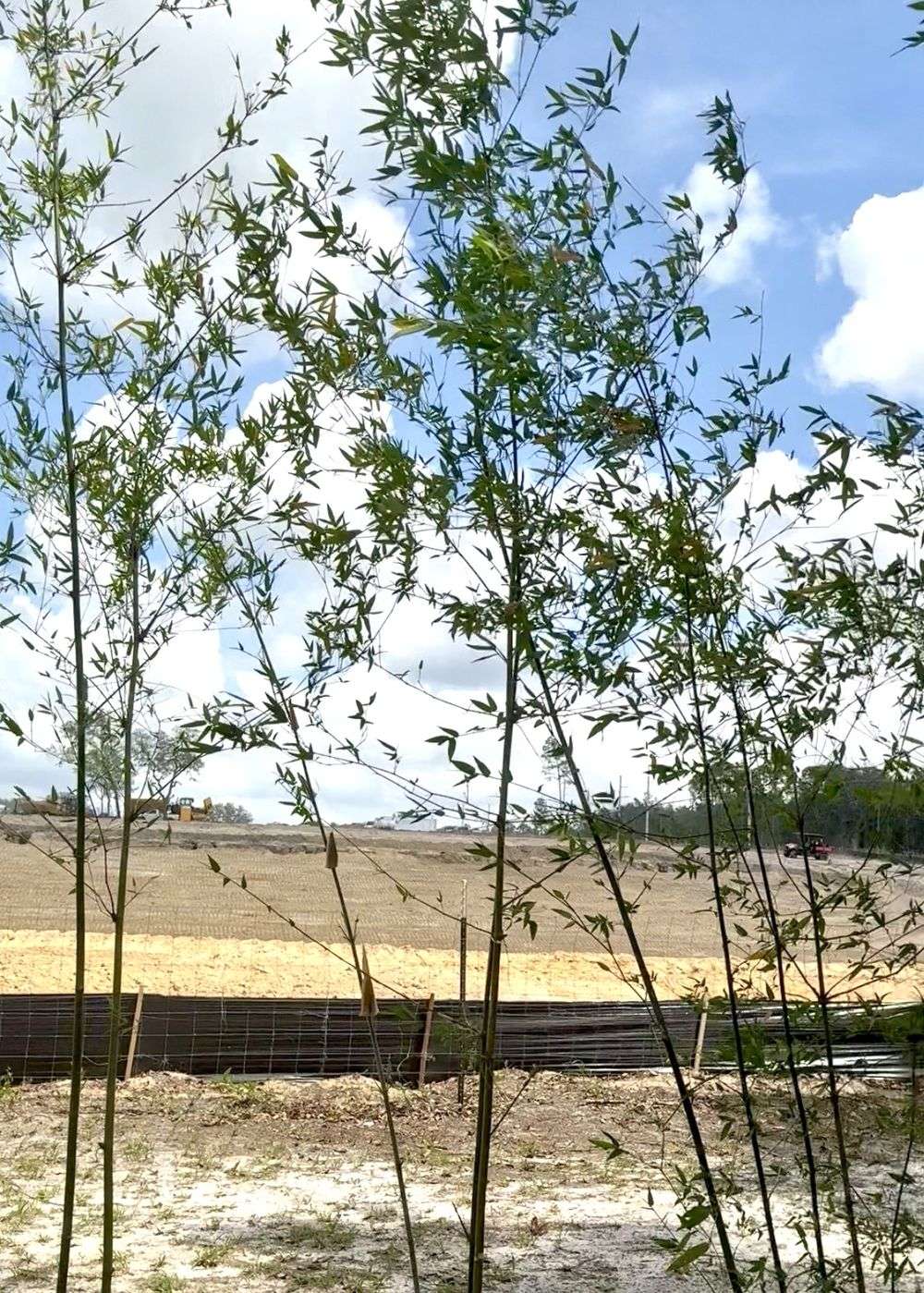
Eighty acres went in next door, forty feet above us, and took the privacy we bought the house for. We priced fencing first, like everyone does. Every quote came back describing a structure that would not have blocked a single window, because the problem was never horizontal.
So we planted instead, and we photographed the same vantage point from January 2025 onward. The slider on our home page is that view, nineteen months apart, unedited. It is the honest answer to “how long does this really take” — slower than a fence in year one, and no contest by year two.
If you want to know what your own run would cost, the Bamboo Selector asks eight questions and gives you a species, a plant count and a price band for your zone and your length. It takes about a minute and there is nothing to fill in first.


